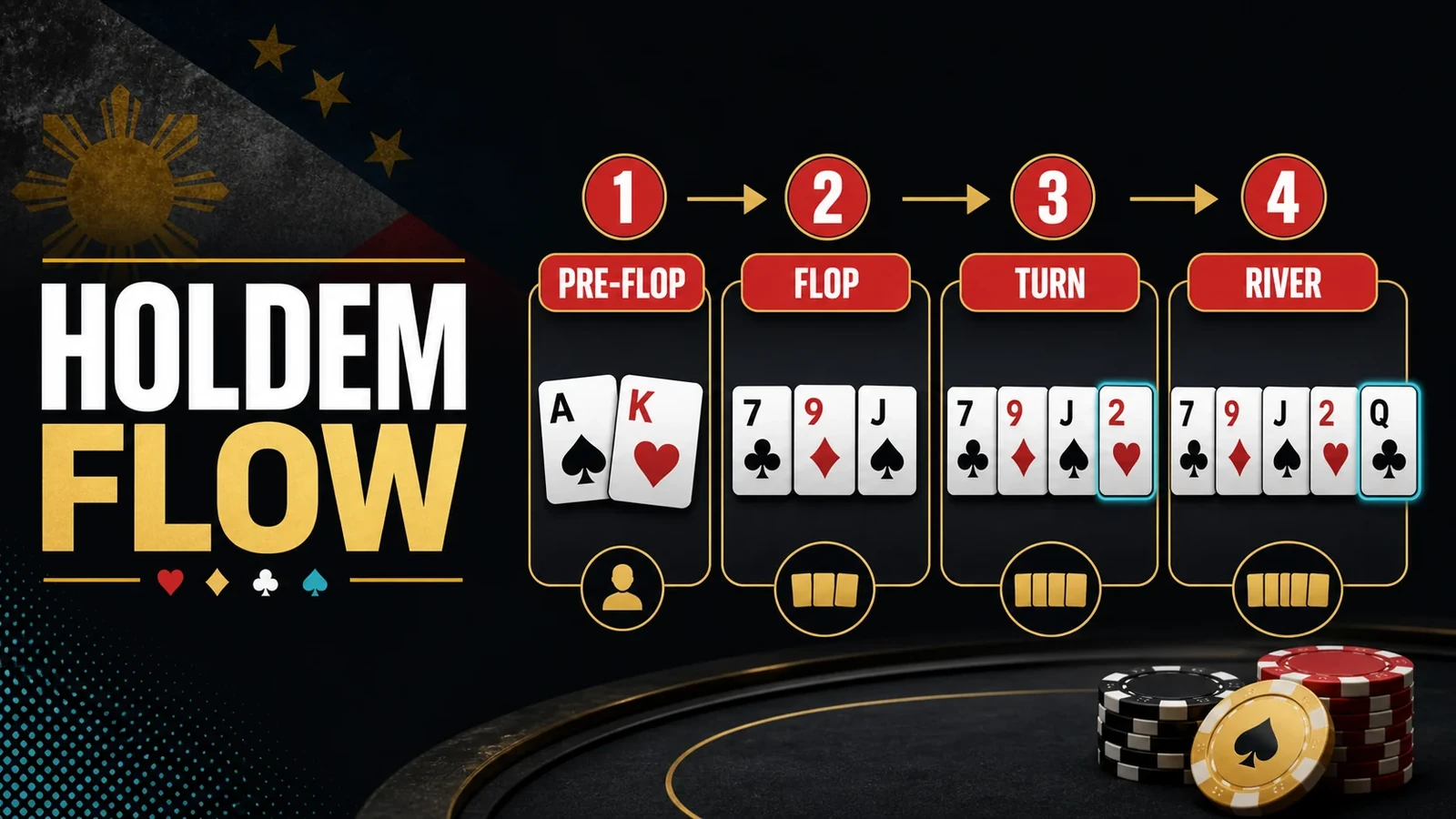
Texas Hold’em uses two private cards for each player and up to five community cards in the middle. You make the best five-card hand available from those seven cards. The action moves through four betting streets: pre-flop, flop, turn and river.
Texas Hold’em is the product term to look for when an online poker Philippines page says “poker.” Check whether the table is cash, tournament or another variant, then confirm the blinds, buy-in, rake and time-out rules. The hand rules below do not prove that any operator or table is suitable.

| Street | What happens | Beginner prompt |
|---|---|---|
| Pre-flop | Two private cards and first action | What is the table cost? |
| Flop | Three community cards | What made hand or draw do I have? |
| Turn | Fourth community card | Did the new card change the situation? |
| River | Fifth card and final action | Can I explain the decision without chasing? |
Hand rankings
- Royal flush
- Straight flush
- Four of a kind
- Full house
- Flush
- Straight
- Three of a kind
- Two pair
- One pair
- High card
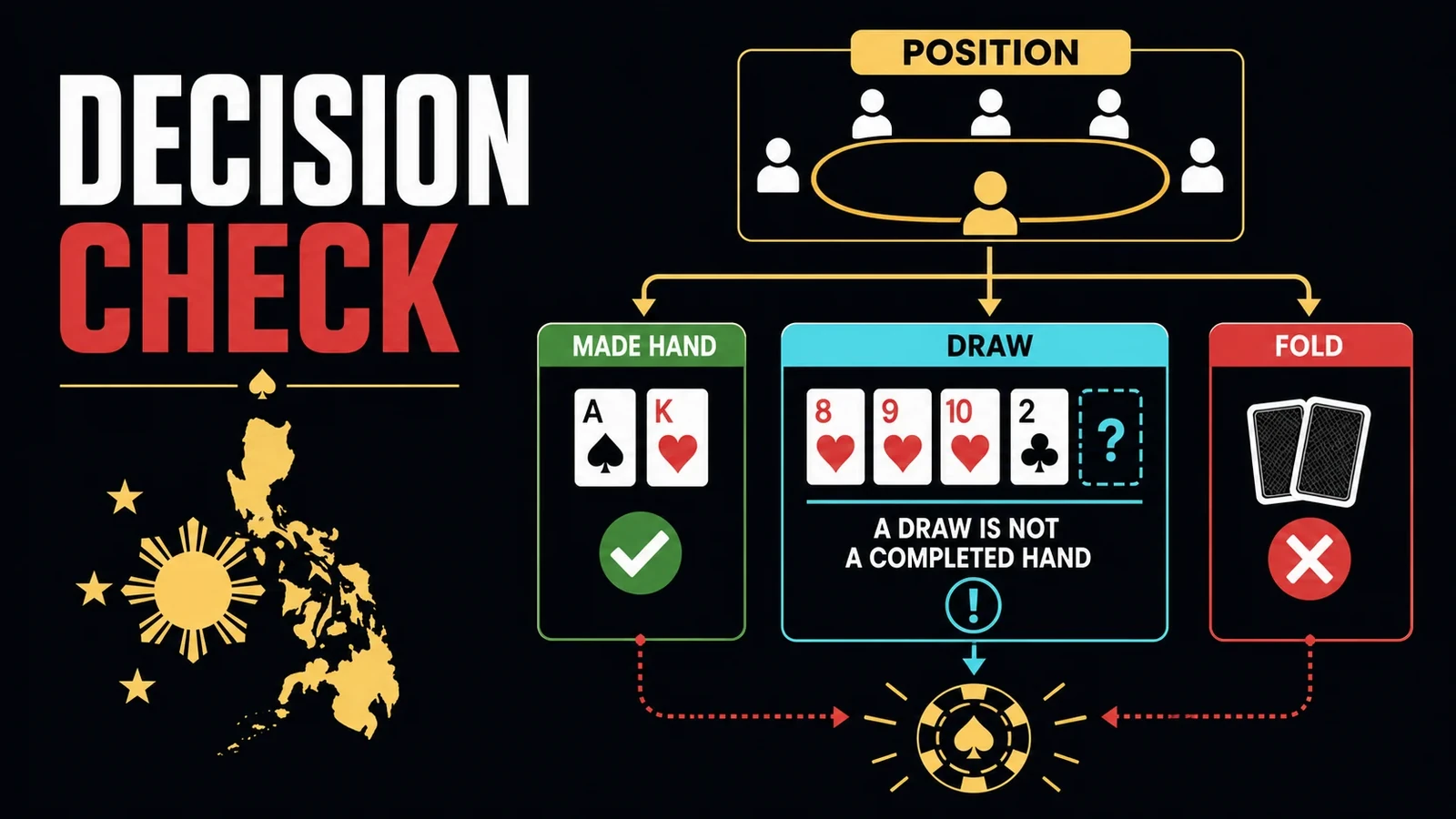
| Decision term | Plain meaning | Limit to remember |
|---|---|---|
| Position | When you act in the round | Information helps, not guarantees |
| Made hand | A completed hand now | Still compare the board and action |
| Draw | A hand that needs another card | A possible hand is not a win |
When two players have the same type of hand, the relevant high cards or kickers decide the comparison. A full house, for example, beats a flush. Keep a ranking chart nearby while learning; no shame sa beginner stage.
How a hand plays
1. Blinds and pre-flop
Two forced bets create the starting pot. Each player receives two private cards, then chooses to fold, call or raise according to the action and table rules.
2. The flop
Three community cards are revealed. Reassess your hand, possible draws and the action before deciding whether to check, bet, call, raise or fold.
3. The turn
A fourth community card appears and another betting round follows. A draw can improve, but it can also miss. Do not count an unfinished draw as a win.
4. The river and showdown
The fifth community card is revealed. If more than one player remains after the final betting, hands are compared at showdown. The best five-card combination wins the pot under the table rules.
Beginner tips that protect your decision-making
- Position matters: acting later gives you more information about what others did, but it does not guarantee a better hand.
- Fold is a valid action: you do not need to continue every hand just because you paid a blind.
- Separate made hands from draws: a possible straight or flush is not the same as a completed hand.
- Watch the pot cost: calls and raises add up. Decide your limit before emotion takes over.
- Do not chase: if you are playing to recover a previous loss, stop the session instead.
Online table checks
Before joining a real-money table, confirm the format, blinds, buy-in range, rake or other fees, time-out rules and account terms. Check the operator’s current age, KYC, payment and withdrawal requirements separately. A poker tutorial cannot prove that an operator is licensed or that a payment method will work for your account.
For the wider topic, see our Philippines poker page, our online-poker beginner guide and the player-check articles. If you are still memorising the rankings, stay with a practice mode where one is genuinely available, or play with no money at stake.
FAQ
Can I use both hole cards?
You may use both, one or neither of your private cards when making the best five-card hand, subject to the variant’s rules. Texas Hold’em is flexible in this way.
Should beginners bluff often?
Bluffing is only one part of poker and is not required in every hand. First learn the action order, hand strength, position and table cost. Never bluff with money you cannot afford to lose.
What is the best starting stake?
There is no guaranteed “best” stake. Choose the lowest level that fits your fixed entertainment budget, read the table limits and stop when your preset limit is reached.
Responsible gaming: players must be 21 or older in the Philippine regulated-gaming context. Poker can involve financial loss even when you study the rules. See PAGCOR’s responsible-gaming information.
Ready to check it out?
Sponsored · Terms may change.